


At some point in life, everyone needs the services of a
financial institution. Offering a variety of monetary transactions, such as
raising capital, loans, and investment, financial institutions are vital in
regulating the economy. As such, different types of financial institutions
offer different services for specific needs.
Here we take a look at the role of financial institutions
(FIs) in the market. Plus, let's understand the types of financial institutions
in Singapore and the purposes that they serve.
What Are Financial Institutions?
A financial institution is an organization that provides different types of financial
services to customers. Some such monetary transactions include:
- Cash deposits
- Loans
- Exchanging securities
- Raising capital
Any Singapore financial institution must be licensed,
approved, and registered or regulated by the Monetary Authority of Singapore.
MAS regulates financial institutions in the capital markets, insurance,
banking, and payment sectors.
Role of the Financial Institutions in the Market
In a nutshell, financial institutions make money available
to individuals and businesses who need it. For example, although banks provide
different services, their main role is to accept deposits and lend funds to
those who need financial assistance. Banks serve as a "middleman"
between depositors and borrowers.
How it works:
These financial institutions use the funds that clients
provide (deposit) and then use the funds to support individuals and businesses
who need them. That said, these organizations make it possible for borrowers to
obtain loans.
Aside from loans, they also help clients raise funds and
invest their money. There are financial institutions that provide investment
services, such as buying and selling securities. While other financial
companies assist clients in managing their money and protecting their assets.
What Are the Types of Financial Institutions?
As previously mentioned, there are various types of
financial institutions that meet your specific needs. They can serve different
types of customers, provide a specific purpose, or focus on certain services,
such as asset management. Here are the main types of financial institutions in
Singapore:
1. Banks
Singapore is a flourishing financial centre and the banking
industry plays a huge role in the financial market segment. In fact, Singapore
is the third largest International Finance Centre in Asia “ after Japan and
Hong Kong.
There are different types of banks, such as the central bank
which is responsible for the oversight and management of all other banks. There
are also commercial and retail banks that offer deposit accounts, lending, and
limited financial advice.
Today, there are approximately 117 foreign banks and 6 local
banks that dominate the banking scene. Retail and commercial banks offer a wide
variety of traditional banking services.
- Deposit
- Savings Accounts
- Loans
- Investments
Private banks, such as Citigroup and Standard Chartered
offer services such as:
- Investment strategies
- Tax and estate planning
- Asset protection
- Credit Services
Most investment banks in Singapore also perform various
corporate-finance and investment-related activities, such as:
- Underwriting securities
- Acting as a broker for institutional clients
- Facilitating mergers and acquisitions
Note: In the US, the Federal Deposit Insurance Corporation
(FDIC) provides insurance for $250,000 per depositor at banks. In Singapore,
the Deposit Insurance Scheme protects your deposits with a member bank for up
to S$75,000 per depositor per bank.
2. Capital Markets
A capital market is a financial institution where buyers and
sellers can buy or sell financial securities, such as bonds, stocks, mutual
funds, and more. The trading is undertaken by participants, such as individuals
and institutions.
Capital market entities in Singapore include:
- Broker-dealers
- Fund managers
- REIT managers
- Corporate finance advisers
- Securities-based crowdfunding operators
- Credit rating agencies
- Approved CIS trustees
- Licensed trust companies
- Financial advisers
Refer to the illustration below for the types of capital
market entities and their Governing Act:
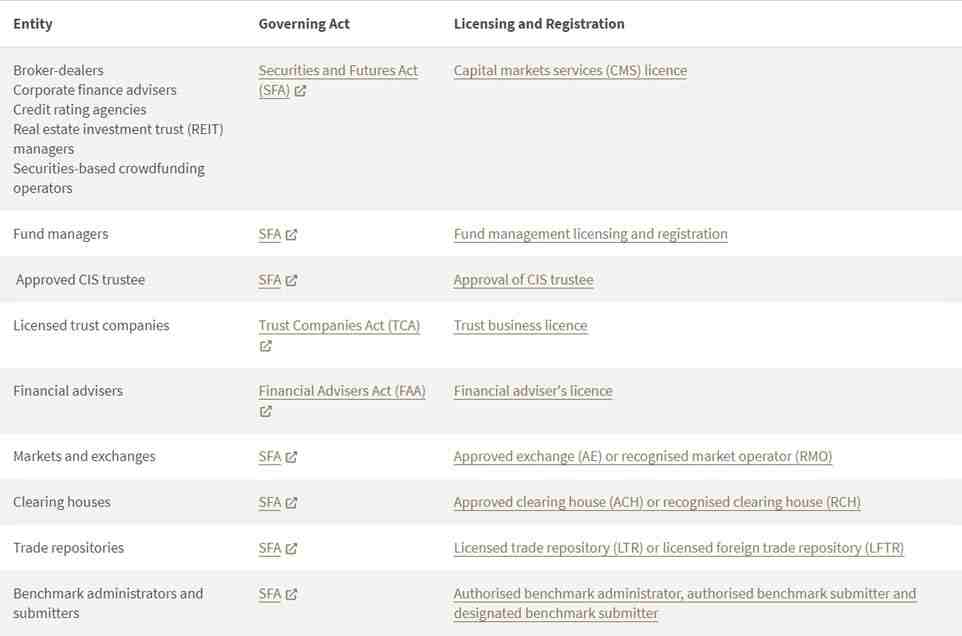
(Source: Monetary Authority of Singapore)
3. Financial Advisory
When you're looking for advice on your financial situation,
a financial advisor can help you achieve your financial goals. Only authorized
firms and individuals are allowed to provide financial advice on investment and
life insurance products.
Financial advisers are licensed and regulated under the
Financial Advisers Act. They provide the following financial advisory services:
- Advising on investment products
- Issuance of research reports covering investment products
- Arranging life policies
Financial advisors will help identify specific goals. They
will also develop a strategy so you will achieve them over time. The strategy
may include buying investment products or life insurance.
4. Insurance
An insurance company is a financial institution that helps
individuals transfer the risk of losses. It is an entity that creates or offers
insurance products to take on the risks in return for premium payments. You can
avail of the services of insurance companies to protect against financial loss
due to death, disability, accident, property damage, and other unfortunate
events.
Insurance companies are licensed and regulated under the
Insurance Act. They carry on direct life and/or general business, life and/or
general reinsurance business, or captive insurance. Only registered or approved
insurance brokers can conduct broking activities.
5. Payments
Payment systems in Singapore have evolved over the years.
From one that was based on paper and cash transactions to one that has a
diverse range of cashless payment instruments. Best of all, these payment
systems have become highly efficient and reliable in clearing and settlement.
Modern payment systems can be categorized into three major
sectors:
- Instruments to deliver payments
- Clearing and settlement of payment transaction
- Transfer of funds between institutions
Payment systems in Singapore can also be categorized by
License Type/Status:
- Credit and Charge Card Licensee: Under the Banking Act,
these entities can carry on the business of issuing credit cards or charge
cards in Singapore.
- Major Payment Institutions: These financial institutions
provide any combination of regulated payment services, regardless of
transactional volume, or e-money held.
- Money-changing Licensee: These entities only provide
money-changing services.
- Designated Payment System Operator: These institutions
operate payment systems designated under the Payment Services Act.
- Standard Payment Institution: They provide any combination
of regulated payment services.
- Designated Payment System Settlement Institution: These
entities settle transactions processed by payment systems designated under the
Payment Services Act.
- Licensed Credit Bureau
Do You Need a Financial Institution?
Financial institutions are crucial in regulating the economy
since they provide a marketplace for money and assets. These entities ensure
that capital is allocated where it is most useful. As such, you need the
services offered by financial institutions on a daily basis.
For instance, if you have a paycheck that needs to be
deposited directly into your bank account, you'll need the services of a
financial institution. These organizations are also essential as you save for
retirement or when you buy a home or if you need protection against losses.
Without financial institutions, you'll have to rely on your
own savings. Say you need capital to start your small business, you'll have to
borrow from family or friends. That said, having access to these institutions
offers you a plethora of opportunities you might not have had without having
access to financial assistance.
Closing
Whether you deposit money for your savings account, save for
retirement, or take out a loan for your dream home, you'll need the services of
a financial institution. All FIs in Singapore are registered and regulated by
the Monetary Authority of Singapore. That said, check whether they are licensed
by MAS before dealing with any financial institution.
Key Takeaways:
- Financial institutions (FIs) make money available to
individuals and businesses who need it.
- FIs are entities engaged in the business of dealing with
financial and monetary transactions including deposits, loans, investments,
insurance policies, and payments.
- The financial services sector includes retail and
commercial banks, credit unions, insurance companies, investment dealers, and
brokerage firms.
Share:


