

Customer support has changed more in the last decade than in
many years before it. Businesses are no longer relying only on phone-based
service and long queues to handle customer needs. Instead, they are shifting
toward smarter, more connected systems that improve speed and experience.
An AI contact center company plays a major role in this shift by offering intelligent
platforms that unify communication channels and automate customer interactions.
At the same time, call center software automation is helping organizations
reduce manual work, speed up response times, and deliver more consistent
service.
Traditional call centers were built around voice-only
communication, where agents handled one call at a time using limited tools and
fragmented customer data. In contrast, modern systems bring together voice,
chat, email, and social messaging into a single intelligent platform powered by
automation and AI.
Today’s customers expect fast responses, personalized
support, and seamless communication across channels. Because of this,
businesses are rethinking how they design their support operations to stay
competitive and meet rising expectations.
Top AI Contact Center Providers and Leading Brands
Several companies are leading innovation in the AI contact
center space. These providers offer tools that help businesses streamline
operations, improve customer experience, and scale efficiently.
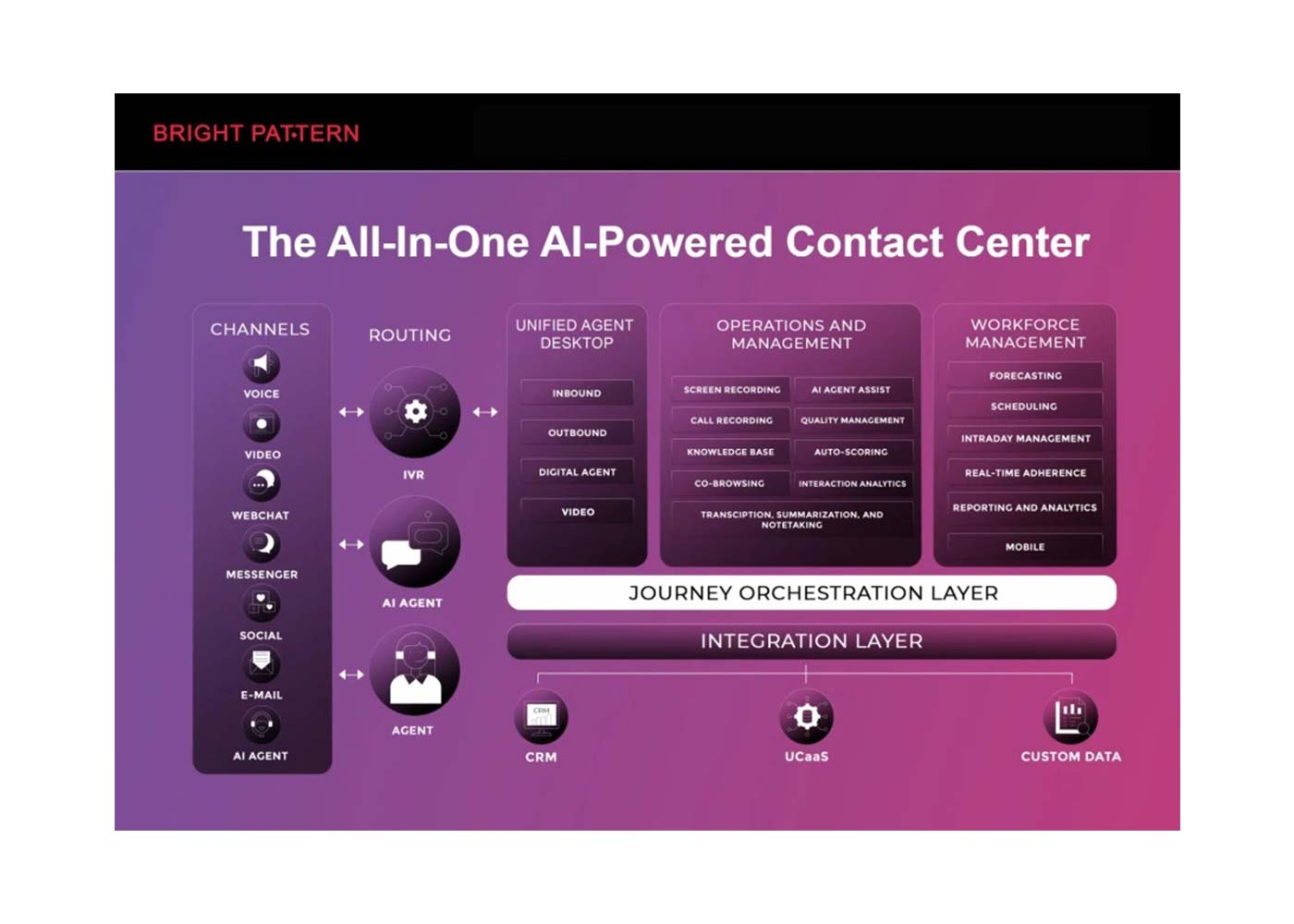
1. Bright Pattern – Omnichannel AI Contact Center Platform
Bright Pattern is widely recognized for its strong
omnichannel capabilities and intelligent automation features. It combines
voice, email, chat, and social messaging into a single unified platform, making
it easier for businesses to manage all customer interactions in one place.
One of its strongest advantages is its ability to blend
automation with human support. It helps businesses reduce response times,
improve routing accuracy, and deliver consistent service across every channel.
For many organizations, Bright Pattern serves as a complete AI contact center
solution that supports both scalability and flexibility.
2. Genesys – Cloud CX and AI-Driven Customer Experience
Genesys provides a powerful cloud-based platform focused on
improving customer engagement through AI, automation, and advanced analytics.
It is widely used by enterprises that need scalable and intelligent customer
service infrastructure.
3. NICE CXone – AI-Powered Customer Service Platform
NICE CXone combines AI-driven insights with workforce
optimization tools. It helps businesses improve agent performance, monitor
interactions, and enhance overall service quality.
4. Five9 – Intelligent Cloud Contact Center Software
Five9 delivers a cloud-native AI contact center platform
that improves productivity through virtual agents, predictive dialing, and
real-time analytics.
5. Talkdesk – AI-Driven Customer Experience Platform
Talkdesk offers a modern and flexible contact center
solution designed to enhance customer engagement through automation and
AI-powered workflows.
6. Amazon Connect – Scalable Cloud Contact Center Service
Amazon Web Services (Amazon Connect) provides a highly
scalable cloud-based contact center solution that integrates with AWS services,
enabling businesses to build customized AI-powered customer experiences.
Defining the Shift from Voice-Only to Omni-Channel Support
Traditional call centers were built for a single purpose: handling
voice calls. Customers would dial in, wait in queues, and eventually speak to
an available agent.
An AI contact center, however, is designed around
omnichannel communication. This means customers can reach support through:
- Voice calls
- Live chat
- Email
- SMS
- Social media platforms
- Messaging apps
More importantly, all these channels are connected. A
conversation can begin on chat and continue on a phone call without losing
context. This seamless experience is now a key expectation in modern customer
service and a major reason businesses are upgrading their systems.
Why Businesses Are Transitioning to an AI Contact Center
The shift toward the AI contact center is being driven by
both customer expectations and business pressure.
Customers want:
- Faster responses
- 24/7 availability
- Personalized support
- Consistent experiences across all channels
At the same time, businesses are dealing with:
- Increasing operational costs
- High call volumes
- Difficulty scaling support teams
- Pressure to improve customer satisfaction scores
AI helps bridge this gap by automating repetitive tasks,
supporting agents in real time, and improving overall service efficiency. This
makes it an essential investment for modern customer experience strategies.
The Role of Artificial Intelligence in Modern CX (Customer Experience)
Artificial intelligence is at the core of the modern AI
contact center. It enhances every stage of the customer journey, from first
contact to resolution.
Key AI capabilities include:
- Intelligent call and chat routing
- Chatbots and Intelligent Virtual Agents (IVAs)
- Predictive analytics for customer behavior
- Real-time sentiment analysis
- Agent assist tools for live support
Instead of relying entirely on manual processes, AI helps
businesses deliver faster, smarter, and more personalized customer
interactions.
Core Architecture: Static vs. Dynamic Systems
Traditional Call Center: Legacy Infrastructure and Manual Routing
Traditional call centers rely on on-premise systems and
static call routing rules. These systems are often rigid, costly to maintain,
and difficult to scale during peak demand.
Because of these limitations, businesses often face
performance issues when call volumes increase suddenly.
AI Contact Center: Cloud-Native and Intelligent Systems
An AI contact center uses cloud-native architecture that
allows real-time scalability and intelligent automation. It can adapt instantly
to changing workloads and customer demand.
Key benefits include:
- Smart routing based on customer intent
- Easy system integration with CRM tools
- Remote accessibility for agents
- Continuous updates without downtime
This makes it far more flexible and future-ready compared to
traditional systems.
Scalability: Managing Growth Without Increasing Headcount
One of the biggest advantages of an AI contact center is
scalability. Instead of hiring large temporary teams during peak seasons,
businesses can rely on AI to handle routine inquiries automatically.
This ensures consistent service quality even during high-demand
periods.
Operational Efficiency and Speed
Reducing Wait Times with Intelligent Automation
Long queues are one of the biggest pain points in
traditional call centers. An AI contact center reduces this issue by providing
instant responses through automation and virtual agents.
Customers get faster resolutions without waiting for the
next available representative.
Intelligent Virtual Agents (IVAs) in Action
Intelligent Virtual Agents can handle a wide range of
customer requests, including:
- Answering FAQs
- Processing simple transactions
- Guiding troubleshooting steps
- Escalating complex cases to human agents
This improves speed while reducing pressure on human teams.
Average Handle Time (AHT) Improvements
Average Handle Time (AHT) is a key performance metric in
customer service.
In traditional environments, AHT is higher due to manual
processes and limited access to data.
In an AI contact center, AHT is reduced because:
- Information is instantly available
- AI suggests responses in real time
- Repetitive tasks are automated
This leads to faster issue resolution and improved customer
satisfaction.
Personalization and Data Utilization
Smarter Use of Customer Data
Traditional systems often provide limited customer data,
forcing agents to search manually during calls.
An AI contact center collects and analyzes data from
multiple channels to build a complete customer profile, improving accuracy and
personalization.
Predictive Analytics: Anticipating Customer Needs
Predictive analytics allows businesses to understand what
customers may need before they even ask.
An AI contact center can:
- Recommend solutions proactively
- Detect potential issues early
- Suggest relevant products or services
This creates a more proactive and helpful support
experience.
Sentiment Analysis for Real-Time Emotion Detection
Sentiment analysis helps detect customer emotions during
conversations. The system can identify whether a customer is frustrated,
neutral, or satisfied and adjust responses accordingly.
This makes interactions feel more human and empathetic.
Human-AI Hybrid Support Model
AI-Powered Agent Assistance
An AI contact center enhances human performance rather than
replacing it. Agent assist tools provide real-time suggestions, knowledge base
articles, and response recommendations during live interactions.
Reducing Repetitive Tasks
Many customer service requests are repetitive. AI can
automate tasks like password resets, order tracking, and account updates,
freeing agents to focus on complex issues.
Improving Employee Experience and Reducing Burnout
By reducing repetitive workloads, an AI contact center helps
improve employee satisfaction and reduce burnout, leading to better performance
and lower turnover rates.
5. Cost-Effectiveness and ROI
Understanding Traditional Costs
Traditional call centers require significant investment in:
- Infrastructure and hardware
- Large staffing teams
- Training and onboarding
- Maintenance and upgrades
These costs increase as demand grows.
Long-Term Value of AI Contact Centers
An AI contact center reduces long-term costs through
automation and cloud infrastructure. While setup may require investment,
operational savings increase over time.
Impact on Customer Lifetime Value (CLV)
Better customer experiences lead to stronger loyalty. Faster
responses and personalized service increase satisfaction, which directly
improves Customer Lifetime Value (CLV).
Choosing the Right Path for Your Business
Signs You Need an AI Contact Center
Your business may need an upgrade if you experience:
- Long customer wait times
- Rising support costs
- Difficulty scaling operations
- Inconsistent service quality
Implementation Challenges
Transitioning to an AI contact center requires planning
around:
- Data security and compliance
- System integration
- Employee training and change management
The Future of AI Contact Centers
The future of the AI contact center includes deeper
automation, more natural conversations, and fully integrated customer journeys
that require minimal human intervention.
Conclusion: Why AI Contact Centers Are the Future
The comparison between traditional call centers and the AI
contact center clearly shows a shift toward faster, smarter, and more efficient
customer service.
Key advantages include:
- Faster response times
- Lower operational costs
- Better scalability
- Improved personalization
- Stronger customer satisfaction
In today’s competitive environment, adopting an AI contact
center is no longer just an upgrade, it is becoming a necessity for businesses
that want to stay relevant and deliver exceptional customer experiences.
Share:


