

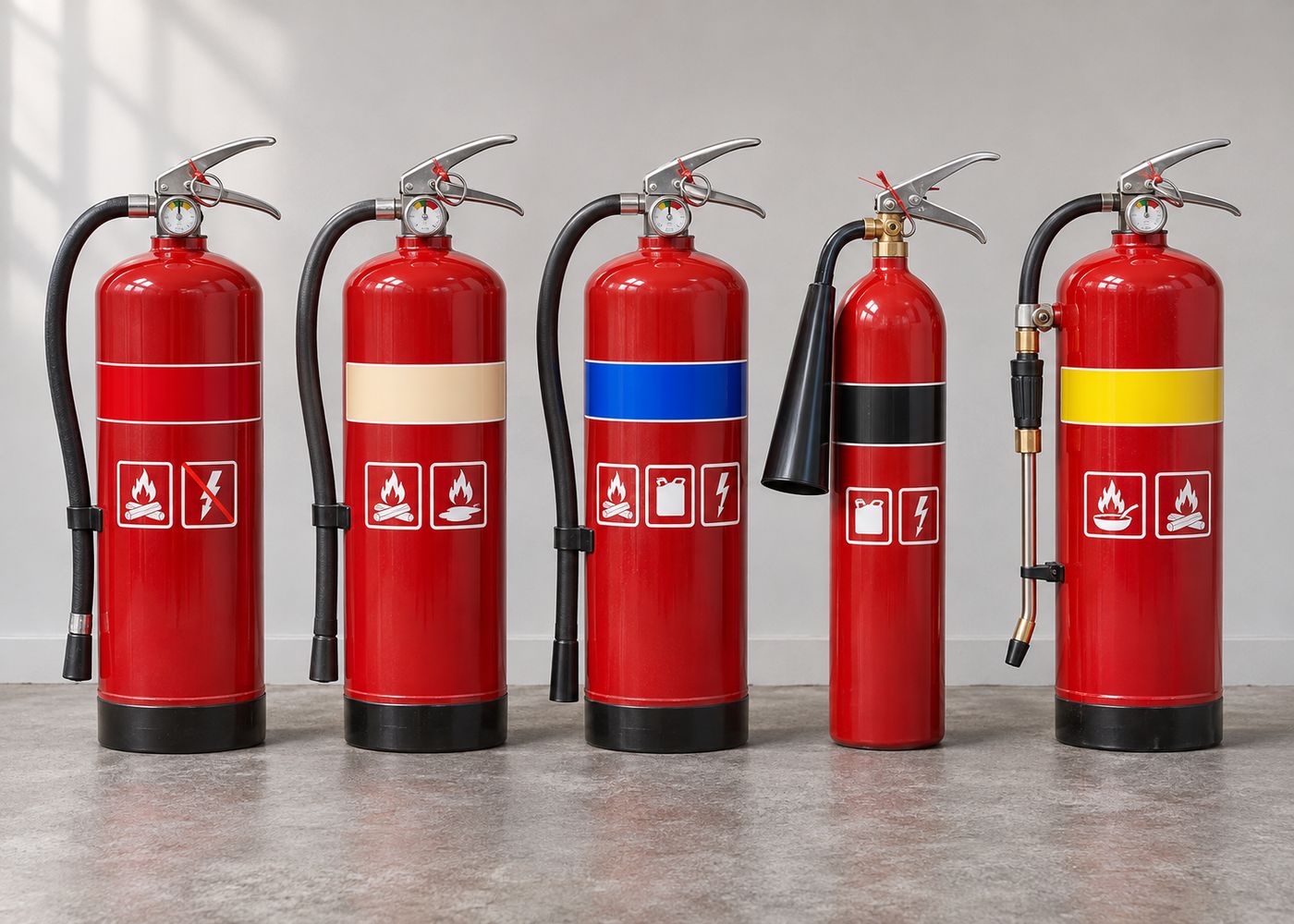
The basic rule is simple: the agent inside an extinguisher must match what is burning, and its label must show it is rated for that kind of fire. Water that puts out burning cardboard can make a pan of burning fryer oil far worse, which is why there are several types of fire extinguishers instead of one that does everything.
Portable extinguishers are only for small fires, so knowing when to leave matters as much as choosing the right one.
Fire classes come before extinguisher types
People often mix up two features. The agent is what comes out, such as water, foam, powder or gas. The rating lists the fire classes that model has been tested for. Two powder extinguishers can carry different ratings, so the rating is the part to read.
Fire classes group fires by their fuel, but the letters change from country to country.
- United States and Canada: A is ordinary combustibles such as wood and paper, B is flammable liquids and gases, C is energized electrical equipment, D is combustible metals, and K is cooking oils and fats in cooking appliances.
- United Kingdom (London Fire Brigade guidance): A is solids, B is liquids or liquefiable solids, C is gases, D is metals, and F is cooking oils and fats.
- Australia: C is flammable gases, E is energized electrical equipment, and F is cooking oils and fats.
So "Class C" means electricity in North America but gas in the UK and Australia. Class K and Class F both describe cooking oil fires, so always read a letter within the system printed on that label.
Classes do not settle every fuel, either. Alcohols are flammable liquids, yet foam may need to be alcohol resistant to work well on them, and the label says whether it is.
Types of fire extinguishers and their uses
Ratings in the table use North American letters unless noted.
| Type | Typically suited to | Key limitations |
|---|---|---|
| Water | Class A: wood, paper, cloth, cardboard | Never on live electrics, flammable liquids or cooking oil |
| Water mist | Class A; some models tested for electrical risk | Electrical use depends on the exact model |
| Foam | Class A and B: solids and flammable liquids | Not for electrical fires in UK fire service guidance |
| ABC dry chemical | Classes A, B and C | Not D or K; residue harms electronics; powder cloud in small rooms |
| BC dry chemical | Classes B and C | No Class A rating |
| CO2 | Classes B and C | Poor on Class A; weak in wind; dangerous in small occupied spaces |
| Wet chemical | Cooking oil and fat (K in North America, F in UK and Australia) | Specialist |
| Clean agent | Depends on model; some larger units carry A, B and C | Check each unit's listing |
| Class D powder | One or more named combustible metals | Must match the exact metal present |
Water, water mist and foam
Water extinguishers work mainly by cooling the fuel, which suits burning paper or furniture. On live electrical equipment they risk electric shock, and on flammable liquids or cooking oil they can spread the fire.
Water mist is only safer near electrics when the maker has tested it that way, as with Amerex models that spray deionized water as a fine mist for Class A fires where a Class C hazard may exist. That does not apply to water extinguishers in general.
Film-forming foam (AFFF) rated for A and B fires lays a floating layer over a burning liquid, which helps stop it reigniting. London Fire Brigade notes that manufacturers are replacing foam containing PFAS, a group of long-lasting chemicals, with fluorine-free foam.
Dry chemical: ABC versus BC
An ABC fire extinguisher usually contains a powder based on ammonium phosphate. It sticks to hot solid materials and forms a coating that cuts the fuel off from air. The US Fire Administration says ABC units cover many common household hazards, but not Class D metals or Class K cooking appliance fires.
A BC unit has no Class A rating, so it is not listed for burning paper towels or a wooden chopping board.
Powder has two downsides. Its residue can damage computers, motors and other equipment, even when the unit is rated for the fire. Hampshire and Isle of Wight Fire and Rescue Service also warns against using powder in enclosed spaces, because the cloud makes it harder to breathe and see while you get out.
CO2 and clean agents
A CO2 fire extinguisher leaves no residue and is listed for Class B and C fires, which is why people choose it over powder near electrical equipment, though it does not guarantee the equipment survives.
Solid materials can keep smouldering and reignite once the gas drifts away, and wind can scatter it before the fire goes out. OSHA warns against using CO2 in occupied confined spaces without breathing protection because it displaces oxygen, and the horn can get cold enough to freeze bare skin.
Clean agents, the replacements for halon, do not conduct electricity, do not corrode and leave no residue. Their class coverage varies by model.
Wet chemical and Class D
A wet chemical fire extinguisher tackles cooking oil by cooling it and by saponification, a reaction that turns the oil surface into a soap-like blanket that blocks oxygen. Some models also carry a Class A rating. In a commercial kitchen with an automatic system, Amerex says to set off that system first and use the portable unit as backup.
A Class D fire extinguisher must suit the particular metal. Class D powder is not ordinary dry chemical, and Amerex warns that some dry chemicals can react explosively on burning metals. Its range includes a sodium chloride model for magnesium, sodium and potassium, and a copper powder model for lithium metal.
What do extinguisher colours and numbers mean?
Colours help, but they are not a universal code. In the UK, London Fire Brigade guidance uses red for water, pale cream for foam, blue for powder, black for CO2 and canary yellow for wet chemical, normally as a band on a red body. Australia uses blue for foam, white for powder and oatmeal for wet chemical. So a blue band means powder in Britain and foam in Australia, which is why the label always comes first.
On a US label such as 2A:10B:C, each unit before A equals the extinguishing power of 1.25 US gallons of water, so 2A equals 2.5 gallons. The number before B is a fire area rating in square feet, and the C confirms the listing for live electrical equipment. These test results do not carry over to European ratings, and they do not mean you can safely fight a real fire of that size.
Do lithium-ion batteries need a Class D extinguisher?
No. A lithium-ion battery is not the same as burning lithium metal. Amerex states that its C571 copper powder extinguisher for lithium metal fires is not recommended for lithium-ion battery fires.
London Fire Brigade advises that if an e-bike or e-scooter battery smokes or catches fire, you should get out, raise the alarm and call the emergency services. A product sold for battery fires does not mean an untrained person can safely stop one.
Two recent changes apply only in certain places:
- Battery class: UK Environment Agency guidance identifies Class L for lithium-ion battery fires in ISO 3941:2026. A new class does not prove that any extinguisher has passed a suitable battery fire test.
- Foam in the EU: Under EU Regulation 2025/1988, supplying portable extinguisher foam with at least 1 mg/L total PFAS was allowed until 23 October 2026 (23 April 2027 for alcohol-resistant foam). Using it in portable extinguishers is allowed until 31 December 2030, subject to other substance rules.
Practical checks, and when to walk away
The US Fire Administration says to use an extinguisher only if others have been alerted, the fire service has been called, you know how to use the unit, the fire is small and contained, smoke is not a threat and your escape route is clear. If you are unsure, get out and call your local emergency number. Early warning matters too, so it helps to understand the different types of fire alarm systems.
Gas fires need extra care. Putting out a burning gas leak while gas still escapes can leave an explosion risk, so evacuate if you cannot shut off the supply easily and safely.
Before relying on any extinguisher:
1. Read the label for the fire classes, the classification system it uses and the instructions.
2. In the US, look for UL Listed or ULC Listed certification, as the US Fire Administration's extinguisher guidance recommends.
3. Choose the largest size the intended user can handle safely and comfortably.
4. Keep it easy to reach and never blocked by furniture or stock.
5. Get training. PASS (pull the pin, aim at the base, squeeze the lever, sweep side to side) is a memory aid, not a replacement for it.
6. Inspect it. Canadian workplace guidance calls for monthly visual checks of pins, seals, nozzles and damage, plus yearly servicing by trained people. Follow your local rules.
Businesses buying equipment can also read our guide on choosing a supplier for fire extinguishers. Whatever you buy, match the agent to the fuel, trust the label over the colour, and leave when the fire is bigger than your plan.
Share:


