

Starting a business is exciting. But at some point, every
founder faces the same question: where does the money come from? Do you fund it
yourself, or do you go looking for outside capital? The answer shapes
everything, from how fast you grow to how much of your company you actually
own.
There is no single right answer. But there are clear signals
that can help you decide.
What Bootstrapping Actually Means
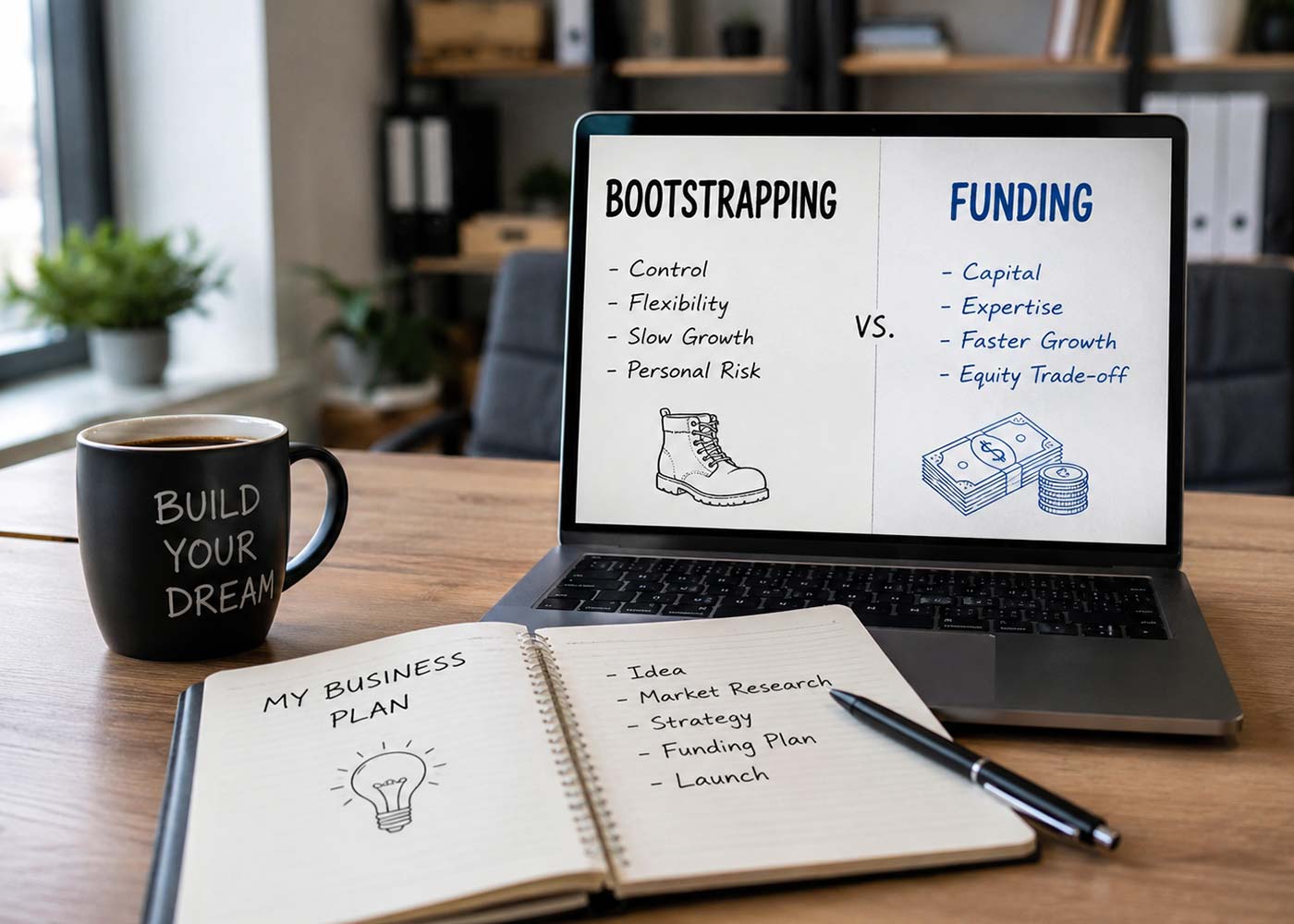
Bootstrapping means building your business with your own
money. That could be personal savings, early revenue from customers, or small
loans you take on yourself. You do not bring in outside investors. You do not
give up any ownership.
Bootstrapping forces founders to enforce financial
discipline and build a lean foundation. When every dollar comes from your own
pocket, you spend carefully. You test ideas faster because you cannot afford to
waste time. You build a business that has to earn its keep from day one.
In 2024, over 38% of startups globally began without
external funding, up from 26% in 2019. That shift is not random. Entrepreneurs
are learning that outside money often comes with strings, and those strings can
pull you in directions you never planned.
Bootstrapping works well when your business can grow at a
steady pace. It suits founders who want full control over decisions, product
direction, and company culture. If your idea does not need a large amount of
cash upfront to work, self-funding is worth serious consideration.
The downside is real, though. Growth is slower. You may miss
market windows while a better-funded competitor moves faster. And if something
goes wrong, it is your personal finances on the line.
When Venture Capital Makes Sense
Venture capital (VC) is money from professional investors
who give you a large sum of cash in exchange for a share of your company. They
are betting that your startup will grow fast and become very valuable. In
return, they expect big returns when you sell the company or go public.
VC funding is particularly strong in sectors like AI, green
technology, fintech, and health tech. If you are building in one of these
spaces and need to move quickly to capture a market, outside funding can make
the difference between winning and being left behind.
VC is a good fit when your business model requires a lot of
money to get started, when you need to hire a large team fast, or when your
window to grow is short. Think about companies that need to build
infrastructure, sign major contracts, or reach a critical number of users
before they can generate real revenue.
But the trade-off is significant. Founders who take VC money
often find themselves as employees in their own companies, with a CEO title and
equity that has been diluted by multiple funding rounds. Investors expect fast
growth. They will push for decisions that maximize returns, which may not
always match what you want for the business.
If speed, scale, and market capture are your top priorities,
venture capital can provide the resources you need. But maintaining control and
staying true to your original vision becomes harder once investors are in the
picture.
The Rise of Fintech Loans
Between bootstrapping and venture capital, there is a
growing middle ground: modern fintech loans and alternative financing.
Revenue-based financing (RBF) is one of the most popular
options today. It bridges the gap between venture capital and traditional
loans, providing funds without the equity demands of the former or the rigid
structure of the latter. You get an upfront amount of cash and pay it back as a
fixed percentage of your monthly revenue. When sales are high, you pay more.
When sales slow down, you pay less.
The global revenue-based financing market reached a total
volume of $5.78 billion in 2024 and is projected to surpass $40 billion by
2028. That growth tells you something. More founders are looking for ways to
get capital without giving away ownership or sitting across from investors who
want a board seat.
There are other options too. Venture debt lets you borrow
money after an equity round without giving up more shares. Government-backed
loan programs such as SBA loans often feature lower interest rates and flexible
structures designed to support early-stage growth. Crowdfunding lets you raise
small amounts from many people, which also doubles as a way to test market
demand.
Combining multiple funding sources, such as grants for
research, revenue-based financing for working capital, and a small equity round
for strategic guidance, can extend your runway while reducing your dependence
on any single source.
How to Know Which Path Is Right for You
Ask yourself a few honest questions before you decide.
Does your business need a large amount of money to get
started, or can it begin small and grow from revenue? If the answer is small,
start with your own funds. If you need a warehouse, a large team, or expensive
technology on day one, outside capital may be necessary.
How fast does your market move? If a competitor with more
money could take your customers in six months, speed matters. VC funding or a
fintech loan can help you move faster than your own savings allow.
How much control do you want to keep? If the company vision
is non-negotiable to you, be careful about who you let in. Every investor you
bring on has an opinion and a financial interest in how things go.
What is your revenue situation? Revenue-based financing
requires that you already have some income coming in. If you are pre-revenue,
your options are more limited. Bootstrapping or angel investment may be your
best path until you have numbers to show.
The Bigger Picture
Funding is not just about the money. It is about the
conditions attached to that money, the relationships it creates, and the
direction it pushes your business.
Entrepreneurs who bootstrap first and prove their model tend
to be in a much stronger position when they do approach investors. They often
end up with better terms, more choices, and more equity.
That does not mean you should always wait. Some businesses
simply cannot grow without outside capital. The key is knowing the difference
between needing funding and wanting it because it feels like validation.
"Securing the right funding is just one piece of the
puzzle; keeping up with evolving market trends and business insights is what guarantees long-term survival."
The founders who thrive long-term are not always the ones
who raised the most money. They are the ones who used what they had wisely,
understood their market deeply, and made funding decisions based on real
business needs rather than pressure or hype.
Start with what you know. Be honest about what your business
actually needs. And choose the funding path that serves the company you want to
build, not just the one that looks impressive on paper.
Share:


