

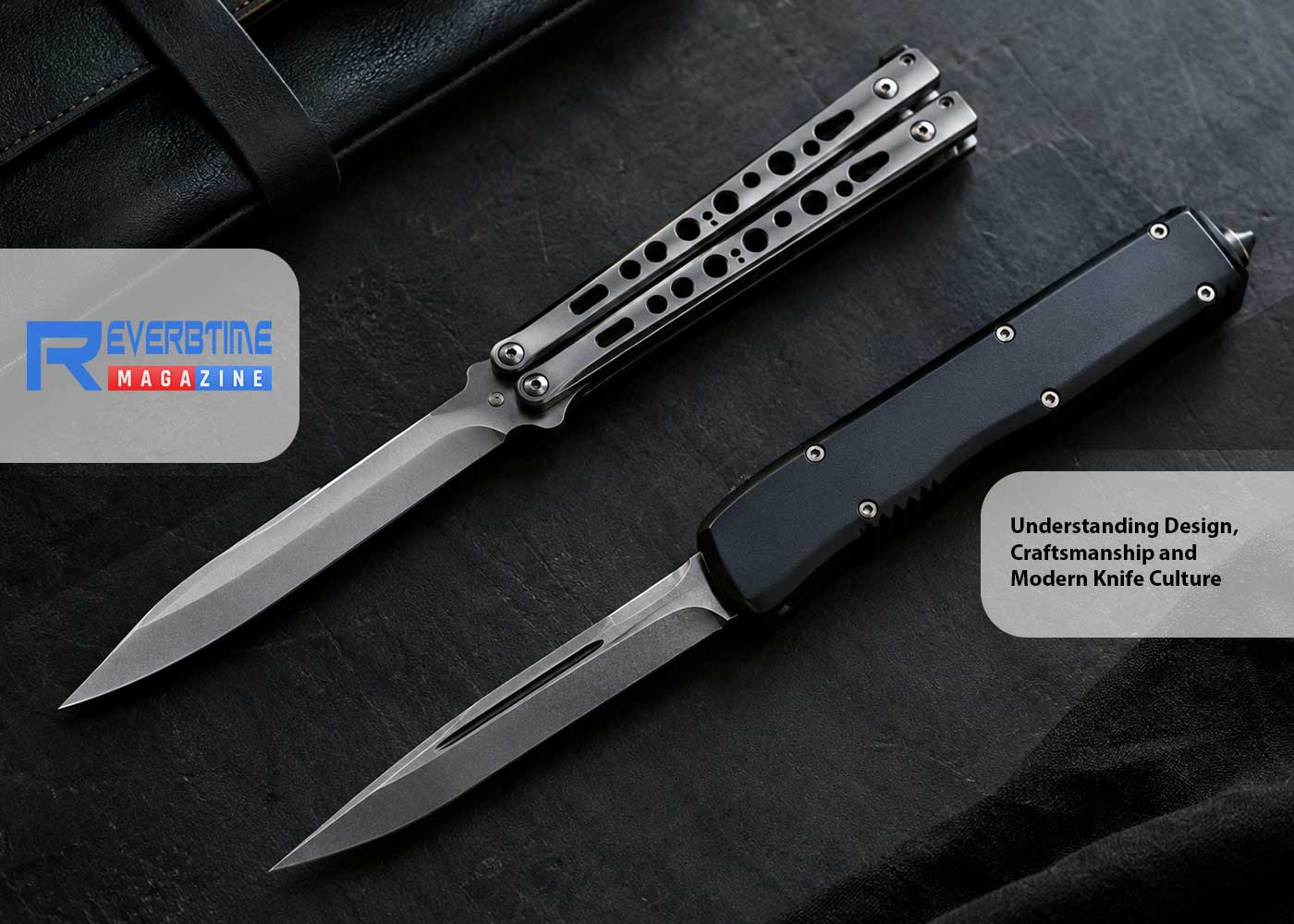
Knives have always occupied an interesting space between
everyday tools, outdoor equipment, collectibles, and mechanical craftsmanship.
A simple folding knife can be appreciated for its practicality, while more
specialized designs often attract people because of the engineering behind
them. Two examples that continue to draw attention are OTF knives and butterfly
knives.
At first glance, the two designs seem to have little in
common. An OTF knife moves its blade through the front of the handle, while a
butterfly knife, also called a balisong, uses two handles that rotate around
the blade. Yet both depend heavily on precision, balance, materials, and
carefully designed mechanical components.
For collectors, outdoor enthusiasts, hobbyists,
tactical-gear businesses, and knife designers, understanding how these knives
are made can be just as interesting as looking at the finished product. The
difference between an ordinary-looking knife and a thoughtfully engineered one
often comes down to details that are easy to overlook.
What Does OTF Mean?
OTF stands for "out the front." The name describes
the basic movement of the blade: instead of swinging sideways around a pivot
like a conventional folding knife, the blade travels through an opening at the
front of the handle.
This creates a distinctive appearance and mechanical layout.
Inside an OTF knife are components that have to work together within a
relatively compact space. Depending on the design, these can include springs,
guides, locking components, a blade carrier, and the mechanism responsible for
controlling deployment and retraction.
There are two broad categories commonly associated with
automatic OTF designs: single-action and double-action.
A single-action OTF automatically deploys the blade, while
returning it to the closed position requires a separate manual process. A
double-action design can generally deploy and retract the blade using the same
control mechanism. The latter requires a more complicated internal arrangement
because the mechanism must reliably manage movement in both directions.
The mechanical complexity is one reason OTF knives have
become interesting to knife enthusiasts. There is considerably more going on
inside the handle than the exterior might suggest.
Why Manufacturing Precision Matters
With a traditional folding knife, the pivot and locking
mechanism are important, but an OTF knife introduces another layer of
engineering. The blade needs to travel through an internal path while
maintaining appropriate alignment with the handle and mechanism.
Small variations in machining can therefore affect the way
individual components fit together. Internal tracks, spring systems, chassis
dimensions, and locking surfaces all need to be manufactured consistently.
This is where CNC machining and quality-control procedures
become particularly relevant. OTF Factory, for example, describes using
multi-axis CNC equipment, in-house assembly, and several stages of inspection
for its OTF, automatic, and butterfly knife manufacturing. Its stated process
includes material verification, dimensional checks, heat-treatment testing,
mechanical tuning, and functional testing.
For a manufacturer working on large production runs,
consistency is especially important. A prototype might function well, but
producing hundreds or thousands of units introduces a different challenge:
every individual component has to remain within the intended specifications.
Butterfly Knives Have a Completely Different Character
Butterfly knives take a very different approach.
Instead of sliding through the handle, the blade is
connected to two separate handle sections. The handles rotate around pivots
and, when closed, generally cover the blade. When opened, they come together to
create the gripping surface.
The design is often called a balisong, and its unusual
construction has made it particularly popular among collectors and knife
hobbyists.
Part of the attraction is mechanical. A well-made butterfly
knife has a certain rhythm to its movement, with the handles rotating smoothly
around their pivots. The balance of the blade and handles can have a noticeable
effect on how the knife feels in the hand.
For manufacturers, this creates its own set of engineering
requirements. The pivot hardware needs to be properly fitted, the handles need
to remain aligned, and the overall construction needs to withstand repeated
movement without excessive looseness.
OTF Factory says its butterfly-knife production involves
checking handle materials for density and weight, precision machining around
pivot systems, and mechanical tuning intended to minimize unwanted handle play
and blade contact.
Materials Can Change the Entire Personality of a Knife
Material selection is not simply about appearance. It can
influence weight, durability, machining requirements, price, and the overall
feel of a finished knife.
Blade steel is one obvious example. Different steels have
different combinations of properties involving edge retention, corrosion
resistance, toughness, hardness, and ease of sharpening. Manufacturers
therefore have to consider the intended market and design before selecting a
particular steel.
Handle materials create another set of possibilities.
Aluminum is popular in many modern knife designs because it
can provide a relatively lightweight structure while allowing manufacturers to
machine detailed shapes. Titanium occupies a different position, often
associated with premium builds and a distinctive combination of strength and
low weight. Carbon fiber and G10 are also used in various knife applications
where weight, grip, appearance, or material characteristics are important.
According to OTF Factory's published manufacturing
information, its customization options include steels such as D2, 8Cr14MoV,
154CM, M390, S35VN, and Damascus, alongside materials including 6061/7075
aluminum, titanium, carbon fiber, and G10.
The right combination depends on the intended design rather
than simply choosing the most expensive material available.
What Makes a Knife "Custom"?
Custom knife manufacturing can mean different things to
different people.
For an individual enthusiast, customization might refer to
the appearance of a particular knife. For a knife brand, however, it can
involve much more. A company may want its own handle geometry, blade profile,
material combination, finish, branding, packaging, and mechanical
specifications.
That is where OEM and ODM manufacturing becomes relevant.
A brand developing a custom otf knife may begin with a rough concept rather than a production-ready
product. The idea can then be translated into technical drawings or 3D CAD
files, followed by engineering work to determine whether the design can be
manufactured consistently.
OTF Factory states that its engineering team accepts 3D CAD
files, technical drawings, and conceptual sketches for custom projects. It also
says that a functional pre-production prototype is produced for approval before
mass production begins.
This prototype stage can be particularly valuable because
mechanical knives are not purely visual products. A design can look excellent
on a computer screen while still requiring changes once physical components are
assembled.
From CAD Model to Finished Knife
Modern knife manufacturing can involve considerably more
technology than the finished product suggests.
The process may begin with a digital model showing the
dimensions and relationships between individual parts. CNC machinery can then
produce components with repeatable dimensions. Critical parts may undergo
additional processes such as heat treatment or surface finishing before
assembly.
Assembly is another important stage. Mechanical knives
require more than simply putting parts together. Springs, pivots, locking
components, and other moving parts need to interact correctly.
OTF Factory describes a process in which experienced
technicians hand-assemble and tune its knives after machining. Its published
quality-control roadmap also describes incoming material checks, in-process
dimensional inspection, hardness testing, specialized assembly, and outgoing
mechanical testing.
That combination of automated machining and human inspection
is worth noting. CNC equipment provides consistency, but experienced
technicians remain important when dealing with assemblies containing multiple
interacting components.
OTF Knives and Outdoor Use
OTF and other folding knives are often discussed in the
context of outdoor activities, camping, hiking, work, and general equipment
collections. However, the usefulness of any knife depends on the specific task,
design, environment, and local regulations.
A knife intended for outdoor use should be considered as a
tool rather than a substitute for appropriate camping equipment. For example,
activities such as preparing food, cutting cordage, opening packaging, or
performing basic camp maintenance may require different characteristics from a
knife designed primarily as a collectible.
Size, blade geometry, handle construction, corrosion
resistance, ease of maintenance, and carrying method can all matter.
For anyone purchasing or importing an automatic or OTF
knife, legal requirements should also be checked before making a decision.
Knife laws vary considerably between countries, states, cities, and individual
circumstances. Rules concerning ownership, purchase, transportation, and public
carry are not necessarily the same.
Why Collectors Pay Attention to Construction
Knife collecting is not only about having a large number of
blades. Many collectors focus on particular mechanisms, manufacturers, steels,
handle materials, finishes, historical designs, or unusual engineering
features.
OTF knives are naturally interesting from this perspective
because the mechanism is largely hidden inside the handle. A collector can
appreciate both the external design and the engineering required to make the
internal system work.
Butterfly knives offer another kind of appeal. Their exposed
pivot-and-handle architecture makes the mechanical character more visible.
Collectors may pay attention to handle construction, pivot hardware, blade
finish, balance, and overall fit and finish.
In both cases, craftsmanship becomes part of the appeal.
Choosing Between OTF and Butterfly Designs
There is no universal answer as to which design is more
appropriate because the two knives are built around different concepts.
An OTF knife emphasizes linear blade movement and compact
mechanical integration. A butterfly knife emphasizes pivoting handles and a
distinctive folding architecture.
For someone interested in mechanical engineering, the OTF
design may be fascinating because so much of its operation happens within the
handle. For a collector who enjoys visible mechanical movement, the
construction of a butterfly knife may be more appealing.
Material choices can also influence the decision. Someone
interested in lightweight construction might look at aluminum or carbon fiber,
while another collector may prefer titanium or a particular premium blade steel
for its material characteristics.
The important point is to look beyond appearance. A knife
can have an impressive finish while still requiring careful consideration of
its mechanism, materials, construction quality, intended purpose, and
maintenance requirements.
The Growing Role of OEM and ODM Manufacturing
The knife industry has also changed as more brands develop
products around specific audiences.
Rather than designing and manufacturing every component
internally, a brand can work with an experienced OEM or ODM manufacturer. This
can allow a company to develop a product around a particular market while
relying on established manufacturing capabilities for engineering, machining,
assembly, and quality control.
OTF Factory identifies itself as a direct OEM/ODM
manufacturer based in Yangjiang, China, and says it works with tactical-gear
brands, distributors, importers, and custom knife designers. The company also
states that its facility has more than 60 CNC machining centers and an annual
production capacity exceeding 1.5 million units.
For businesses, this type of manufacturing relationship can
be useful when consistency matters as much as the original design. A successful
knife has to be repeatable. The tenth unit should reflect the same
specifications as the first approved production sample.
Responsible Knife Ownership Still Matters
Regardless of the design, knives should be treated as sharp
tools with the potential to cause injury if handled carelessly. Automatic and
butterfly mechanisms deserve particular attention because their moving parts
can behave differently from conventional folding knives.
Users should understand the instructions supplied with a
knife, keep blades properly maintained, and store them securely when they are
not being used. When transporting a knife, local laws and restrictions should
be checked rather than assuming that regulations are the same everywhere.
For businesses selling knives internationally, legal
compliance becomes even more important. Product design, packaging, shipping,
advertising, and destination-market regulations can all create separate
requirements.
Looking Beyond the Blade
The most interesting part of a modern OTF or butterfly knife
may not actually be the blade. It can be the engineering hidden around it.
A successful design brings together steel selection,
machining, tolerances, handle materials, mechanical components, finishing,
assembly, inspection, and practical considerations. When all of those elements
work together, the result is more than an attractive piece of equipment. It
becomes an example of compact mechanical design.
That is ultimately what makes OTF and butterfly knives so
interesting to collectors, outdoor enthusiasts, hobbyists, and businesses in
the tactical-gear market. Their appeal comes from a combination of function,
construction, design, and craftsmanship.
As manufacturing technology continues to develop, custom
knife production is likely to become even more precise and flexible. At the
same time, the fundamentals remain familiar: good materials, careful
engineering, consistent machining, skilled assembly, responsible use, and
attention to detail.
Share:


