

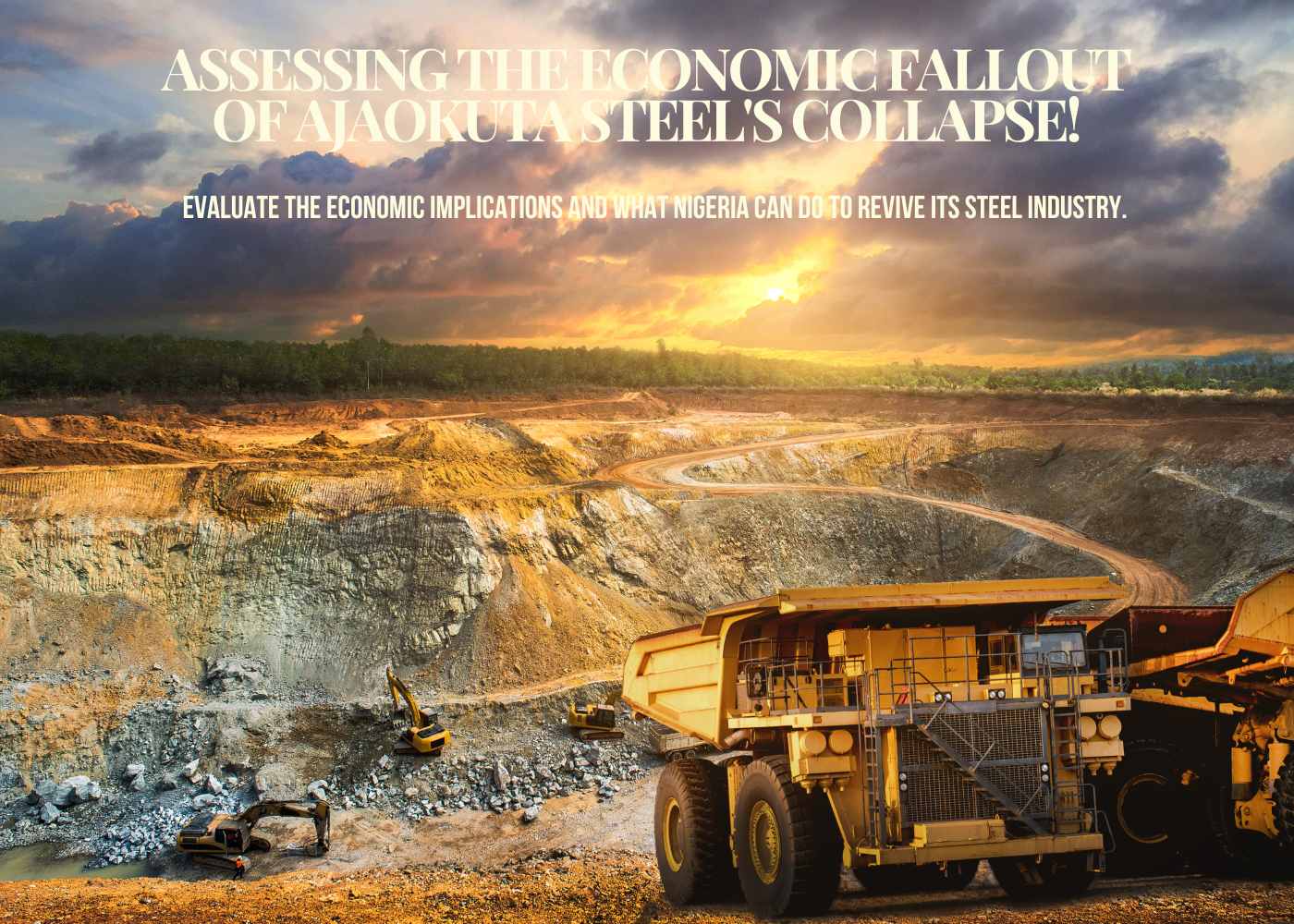
Imagine a colossal factory that was built to change the
course of a nation's economy, designed to be a hub of industrial activity,
employing thousands of workers, and creating opportunities for millions more.
Now, imagine that factory standing silent, its machines gathering dust, its
workers paid but idle. This is the tragic reality of the Ajaokuta Steel Company in Nigeria—a project that was once the symbol of hope for industrialization but
has since become a stark reminder of mismanagement, corruption, and lost
potential.
Conceived in 1979, the Ajaokuta Steel Company was intended
to be the backbone of Nigeria's industrial revolution. The plan was ambitious:
to establish a state-of-the-art steel production facility that would generate
significant upstream and downstream industrial activities, thereby diversifying
the nation's economy away from its over-reliance on oil. At its peak, the
company was expected to directly employ about 10,000 workers, with ancillary
industries creating jobs for half a million Nigerians.
Yet, over 40 years later, the Ajaokuta Steel Company remains
incomplete. Despite being 98% finished by 1994, it has never produced a single
sheet of steel. Meanwhile, the Nigerian government has continued to pay the
company's workers—over N38.9 billion in salaries and allowances over the past
decade alone—without any return on investment. This article delves into the
complex history of the Ajaokuta Steel Company, the reasons behind its failure,
and the ongoing efforts to revive it.
The Birth of Ajaokuta: A Visionary Dream
The story of the Ajaokuta Steel Company begins in the late
1970s, a period of great optimism and ambition in Nigeria. The country had
recently emerged from a civil war, and the government was keen to diversify its
economy, which was heavily dependent on oil. Steel production was identified as
a critical component of this strategy, given its importance in construction,
manufacturing, and infrastructure development.
In 1979, the Nigerian government agreed with the Soviet
Union to build the Ajaokuta Steel Complex. The project was designed to be an
integrated steel plant, meaning it would produce steel from raw iron ore, which
would then be used to manufacture a wide range of products. The complex was to
include a Metallurgical Process Plant, an Engineering Complex, and various
auxiliary facilities.
Construction of the plant began in earnest, and by 1994, it
was reported that 98% of the equipment had been installed. The first phase of
the plant was expected to employ around 10,000 workers, and the impact on the
local and national economy was anticipated to be transformative. However, as
the years passed, the project began to falter.
The Decline: Mismanagement and Corruption
Despite its initial promise, the Ajaokuta Steel Company
never reached its full potential. A combination of factors contributed to its
decline, including poor management, lack of political will, and widespread
corruption. As successive governments came and went, the project was neglected,
with little effort made to address the issues that were holding it back.
One of the key problems was the lack of proper planning and
coordination. The Ajaokuta Steel Complex was designed to rely on raw materials
from the Itakpe Iron Ore Mine, which was supposed to supply the plant with the
necessary iron ore. However, the Itakpe mine faced its own set of challenges,
including delays in development and transportation issues, which meant that the
steel plant never received the raw materials it needed to begin production.
Additionally, the project was plagued by corruption and
mismanagement. Funds allocated for the completion and operation of the plant
were often misappropriated, and there was little accountability for the failure
to deliver on the promises made. As a result, the plant remained incomplete,
and its workers were left idle.
The Human Cost: Workers Paid to Do Nothing
One of the most troubling aspects of the Ajaokuta Steel
Company's story is the fate of its workers. Despite the plant's inability to
produce steel, the Nigerian government has continued to pay the salaries and
allowances of the company's employees. Over the past decade, this has amounted
to a staggering N38.9 billion—a significant sum in a country where many
struggle to make ends meet.
For the workers themselves, this situation has been a source
of deep frustration and despair. Many of them joined the company with high
hopes, believing that they were contributing to a project that would help build
Nigeria's future. Instead, they have spent years waiting for a plant that never
became operational, their skills and expertise wasted.
The payment of salaries to idle workers also represents a
broader failure of governance. The funds used to pay these workers could have
been invested in other critical areas, such as education, healthcare, or
infrastructure. Instead, they have been used to sustain a project that has yet
to deliver any tangible benefits to the Nigerian people.
Attempts at Revival: A Flicker of Hope
Despite its troubled history, there have been several
attempts to revive the Ajaokuta Steel Company over the years. In 2019, at the
Russia-Africa Summit, former Nigerian President Muhammadu Buhari and Russian
President Vladimir Putin agreed to collaborate on revitalizing the steel mill.
The plan was to secure funding from the African Export-Import Bank
(Afreximbank) and the Russian Export Centre to complete the project and bring
it into operation.
However, the onset of the COVID-19 pandemic disrupted these
plans, and the agreement was eventually abandoned. The pandemic created new
challenges for international cooperation and project financing, and the
momentum for the Ajaokuta revival was lost.
In January 2024, there was renewed hope when Nigerian
President Bola Tinubu opened discussions with a Chinese steel company, Luan
Steel Holding Group, to explore the possibility of reviving the Ajaokuta Steel
Company. This development was seen as a positive step, but it remains to be
seen whether it will lead to tangible results or become yet another false dawn
in the long saga of Ajaokuta.
The Bigger Picture: Lessons for Nigeria's Industrialization
The story of Ajaokuta Steel Company is not just about a
failed project; it is a reflection of broader challenges facing Nigeria's industrialization
efforts. It highlights the importance of proper planning, effective management,
and political will in executing large-scale infrastructure projects. It also
underscores the need for transparency and accountability in the use of public
funds.
For Nigeria to achieve its industrialization goals, it must
learn from the mistakes of Ajaokuta. This means ensuring that future projects
are carefully planned and managed, with clear timelines and deliverables. It
also means creating an enabling environment for private sector investment,
which can provide the capital and expertise needed to drive industrial growth.
Conclusion
The Ajaokuta Steel Company represents a colossal missed
opportunity for Nigeria—a project that could have transformed the country's
economy but has instead become a symbol of failure. The payment of N38.9
billion in salaries to idle workers over the past decade is a stark reminder of
the cost of mismanagement and neglect.
However, the story of Ajaokuta is not yet over. There is
still hope that the plant can be revived and put to productive use. This will
require strong leadership, effective management, and a commitment to
transparency and accountability. It will also require the involvement of all
stakeholders, including the government, private sector, and international
partners.
As Nigeria looks to the future, it must take the lessons of
Ajaokuta to heart. The country has the potential to become an industrial
powerhouse, but this will only be achieved if it is willing to address the underlying
issues that have held back projects like Ajaokuta. The time for action is now,
and the stakes could not be higher. Nigeria's future depends on its ability to
learn from the past and forge a new path forward.
Share:


