

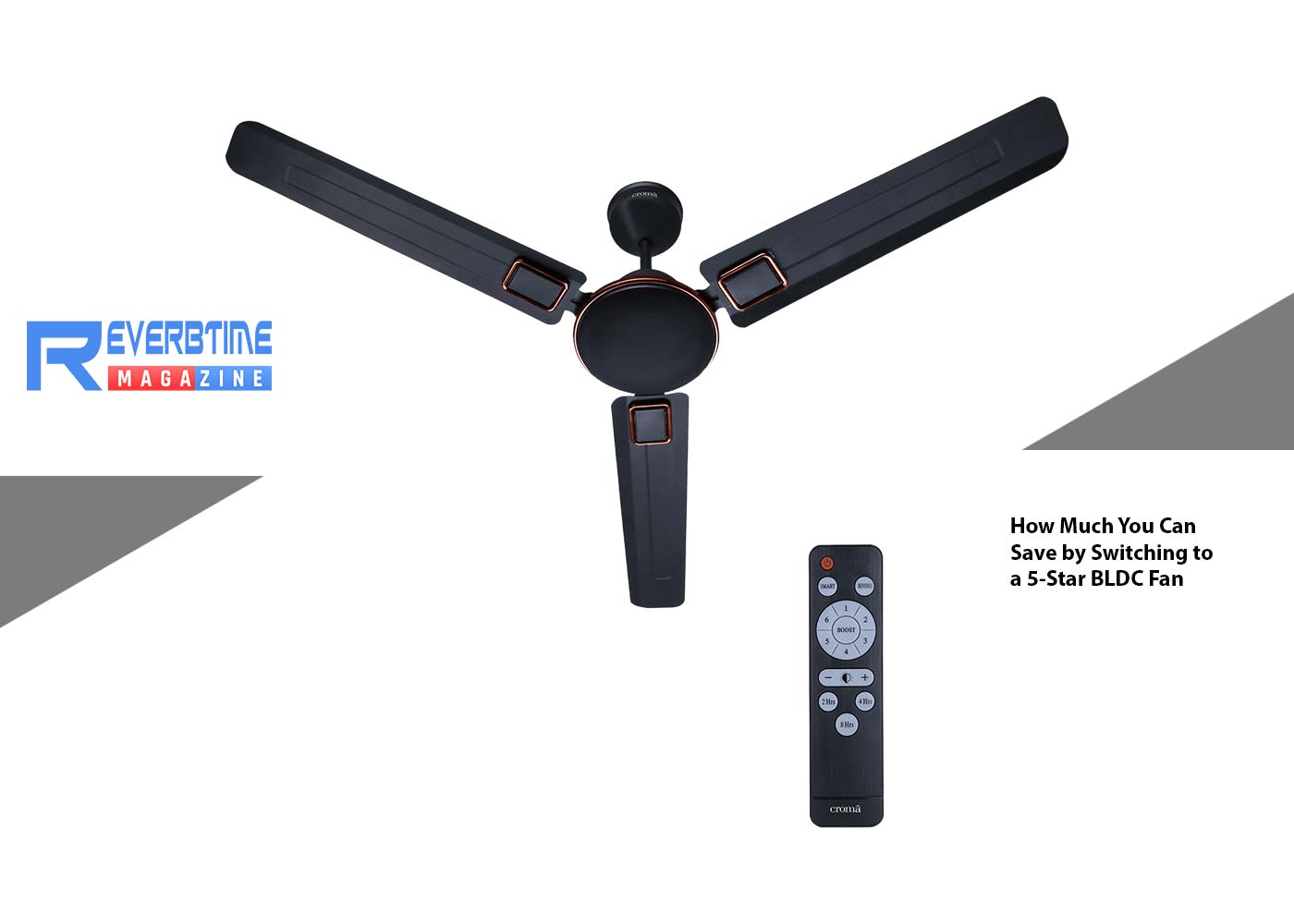
Every Indian household running ceiling fans through summer
knows the feeling the electricity bill arrives in May or June and the number is
quietly alarming. Most people blame the air conditioner. The fans rarely get
questioned. But if your home is running three or four conventional ceiling fans
for ten hours a day, they're adding far more to that bill than most people
realise. Switching to a 5-star BLDC fan is one of the few home upgrades that
genuinely pays for itself and faster than you'd expect.
Here's what the numbers actually look like.
What's Wrong With the Fan You Already Have
Most ceiling fans installed in Indian homes before 2020 run
on conventional induction motors. They work fine in the basic sense they spin,
they move air. The problem is efficiency. A typical conventional fan consumes
between 60 and 75 watts at full speed. Run it ten hours a day and that's 0.6 to
0.75 units of electricity. Per fan. Per day.
Multiply that out. Three fans running ten hours a day for
300 days adds up to roughly 540 to 675 units annually just from the fans. At ₹7
to ₹9 per unit, which covers most Indian states, that's anywhere between ₹3,780
and ₹6,075 a year. If you're already thinking about the best ceiling fan to
replace what you have, that number is exactly why the switch makes sense.
The conventional induction motor hasn't changed meaningfully
in design since the 1960s. It was built to be cheap to manufacture, not to be
efficient to run.
What the BLDC Motor Is Actually Doing Differently
BLDC stands for brushless direct current. It uses a
permanent magnet rotor and an electronically controlled stator which means it
converts electricity to motion with considerably less heat loss than a
conventional motor. Less heat loss means less electricity wasted on warming up
a motor instead of spinning a blade.
A 5-star BLDC ceiling fan typically consumes between 28 and
40 watts at full speed. That's roughly half the consumption of a conventional
fan moving the same volume of air. Atomberg's Renesa, one of the most widely
sold BLDC fans in India, runs at 28 watts. The Orient Aeroquiet BLDC comes in
at around 28 to 32 watts. Both deliver airflow figures measured in CMM, cubic
metres per minute comparable to conventional fans consuming 65 to 70 watts.
The BEE overhauled its ceiling fans star rating framework in
2023. The revised system measures service value: airflow delivered per watt
consumed. A 5-star rating under the post-2023 framework is meaningfully harder
to earn than it was before. If you're buying now, check that the fan carries
the current BEE label not an older one.
The Savings, Run Properly
Here's how the numbers compare for a typical three-fan
Indian home running ten hours a day across 300 days:
|
Setup |
Watts Per Fan |
Annual Units (3 fans) |
Annual Cost at ₹8/unit |
|
Conventional 3-star fan |
70W |
630 units |
₹5,040 |
|
5-star BLDC fan |
32W |
288 units |
₹2,304 |
|
Annual saving |
|
342 units |
₹2,736 |
That's a saving of roughly ₹2,700 to ₹3,000 per year across
three fans before accounting for the fact that BLDC motors run quieter, last
longer, and give you proper low-speed operation without the motor humming or
hunting for torque.
Pricing on mainstream 5-star BLDC ceiling fans currently
sits between ₹2,500 and ₹3,500 for most models. The Atomberg Renesa 1200mm is
available at approximately ₹2,799. The Orient Aeroquiet BLDC is priced
similarly at around ₹2,500 to ₹3,000 depending on finish and retailer. Against
an annual saving of ₹2,700 across three fans, the payback period works out to
18 to 22 months. After that, the saving runs for the life of the fan typically
10 to 15 years with a BLDC motor.
The Fans That Are Actually Worth Buying
Not every fan sold as BLDC earns it. Some models carry the
label while delivering wattage closer to 50 or 55 watts which blunts the
efficiency case considerably. When you're shortlisting, look for published
wattage below 35W, a CMM figure above 200 for a 48-inch fan, and a service
network that covers your city.
A few models with verified specs worth considering:
- Atomberg Renesa 1200mm 28W, 5-star, remote-controlled,
₹2,799 approximately; one of the most reliably efficient BLDC fans on the
Indian market
- Atomberg Efficio+ 28W, simpler design without remote,
slightly lower price point, suits utility spaces
- Orient Aeroquiet BLDC 28 to 32W depending on variant,
noticeably quiet at all speeds, well suited to bedrooms
- Crompton Energion HS around 50W, higher than the others
but still significantly below conventional fans; better suited to larger rooms
where airflow output matters more than pure watt savings
Prices shift across platforms and sale periods treat the
figures above as a baseline, not a guarantee.
The Upgrade Most People Keep Putting Off
Ceiling fans get deprioritised because they don't feel
urgent the way a failing AC or a leaking geyser does. But the maths makes a
reasonable case for moving them up the list. Replacing a ceiling fan takes
thirty minutes and a standard electrician visit. The disruption is minimal. The
saving starts immediately.
One more thing worth knowing: BLDC fan savings stack on top
of every other efficiency upgrade you make. They don't compete with solar
installations or inverter battery
upgrades they run independently alongside them. A household that switches to
BLDC fans and adds a 2kW rooftop solar system saves on both counts
simultaneously.
Conclusion
Conventional ceiling fans have been a quiet but consistent
drain on Indian electricity bills for decades. The 5-star BLDC options
available today aren't a marginal step forward they use roughly half the
electricity for equivalent or better airflow, return the purchase cost within two
years, and then reduce your bill every month for a decade after that.
The bill arriving next summer reflects the fans running in
your home today. It's one of the easier things to change.
Share:


